

Minimum Viable Metaphysics Version 2

Introduction to Version 2.0
A few months ago I published “A Minimum Viable Metaphysics” an essay laying out what I take to be the bare minimum metaphysical commitments needed to get traction on understanding anything at all. Three planks: reality, asymmetry, lawfulness. From those, emergence does the heavy lifting.
I was gratified by the response. The piece found readers among academic philosophers, armchair philosophers, scientists, writers, and random smart folks—plus, of course, the usual smattering of internet nuts and cranks. Some of the feedback was correct and useful. So I’ve decided to issue an extended Version 2.0.
What’s changed?
The biggest addition is a fourth commitment: causal time. Version 1 left this implicit; several readers correctly pointed out that was too minimal. If you’re going to ground emergence, you need genuine temporal becoming—things actually happening, causes producing effects, the causal graph building on itself. I now engage directly with the block universe view and explain why I reject it. I’ve also added a brief discussion of assembly theory, which provides empirical motivation for taking temporal becoming seriously rather than just philosophical preference.
I’ve also expanded the asymmetry commitment substantially. We don’t yet know whether the universe is fundamentally deterministic or fundamentally stochastic, and the two cases differ in important ways. In a deterministic universe, asymmetry must have been baked into the initial conditions. In a stochastic universe, quantum fluctuations can generate asymmetry spontaneously. Either way we need it—but the source of the asymmetry differs. This seemed worth spelling out.
On the other hand, I’ve dropped some claims as “more than minimal.” The infinity discussion is gone—whether the universe is finite or infinite is an open question that the framework doesn’t need to settle. I’ve also backed off the suggestion that meaning follows directly from the four commitments. It doesn’t; meaning remains contested and under-mapped. Developing naturalistic accounts of meaning is work for another day.
Finally, I’ve added a section called “Is This Enough?” that preemptively addresses the obvious objection that I’ve ducked the hard questions—materialism versus idealism, determinism versus free will, reductionism versus holism. Short answer: yes, I’ve ducked them, and that’s the point. The framework is deliberately neutral on debates it doesn’t need to resolve.
The net result is that Version 2.0 is longer and more defensive. It argues where Version 1 declares. Version 1 plants the flag; Version 2 defends the hill. If you want the elevator pitch, read Version 1. If you want to see how the position handles obvious objections, read this one.
Thanks for the excellent feedback. I’m game for a Version 3.0 if need be.
A Minimum Viable Metaphysics: Four Commitments to Ground Inquiry Version 2.0
Philosophy has a chronic tendency toward metaphysical obesity. Systems grow elaborate, categories multiply, and before long we’re carrying palaces of being on our backs when a few sturdy planks would suffice. The question worth asking is not “what is the ultimate nature of reality?” but rather “what minimal metaphysical commitments do we need to get traction on understanding anything at all?”
This essay proposes four such commitments—and only four. These are not axioms to be proven, nor claims to absolute certainty. They are deliberate, provisional wagers we must make if inquiry is to have an object and a method. Call this a minimum viable metaphysics: just enough structure to keep the world from sliding out from under our feet, just enough looseness to let investigation breathe.
The four commitments are: that the universe exists and is real; that it exhibits or came to possess asymmetry; that it operates lawfully; and that causation through time is genuine. From these bare stakes, everything else we care about—emergence, complexity, novelty—follows as a consequence rather than an assumption. The heavy lifting gets done by the universe itself, not by our metaphysical architecture.
Commitment 1: The Reality Principle
The universe exists. It is not a mirage, not a simulation within some larger reality, not a dream from which we might awaken. It persists and resists. It appears to have originated approximately 13.8 billion years ago—the Big Bang is not certain, but it is the best current model. The universe is vast. Whether it is literally infinite or merely immense beyond comprehension is an open question that minimum viable metaphysics need not settle. What matters is that it is real and persistent.
Within this universe, time and space at the human scale—what we might call the mesoscale between the Planck length and the cosmological horizon—are mostly what they seem. Clocks tick forward. Rulers measure distances. Ordinary dynamics behave in regular, predictable ways at the scales where we live and operate. This does not mean our intuitions about time and space are perfect—relativity and quantum mechanics have shown otherwise—but it means they are reliable enough at human scales that we can build upon them.
This is a fragile commitment. It cannot be proven from within its own frame. A skeptic might propose that the universe blinked into existence five seconds ago, complete with fossils, memories, and the light from distant galaxies already in flight. This scenario cannot be strictly refuted through logic alone. Yet if we do not make this commitment, investigation loses its object entirely. There is nothing to investigate if reality itself is in question at this fundamental level.
So we commit. Deliberately, provisionally, but decisively. We take the universe to be real, not because we can prove it with certainty, but because without this assumption, inquiry has nowhere to begin. This is not naive realism—we acknowledge the commitment is made consciously and could in principle be wrong—but it is realism nonetheless. The alternative is paralysis.
Commitment 2: The Asymmetry Principle
At or near its origin, the universe was not perfectly uniform. There were ripples—tiny departures from perfect sameness. These asymmetries are observable in the cosmic microwave background radiation, where temperature fluctuations of about one part in one hundred thousand reveal the density variations that eventually grew into galaxies and large-scale structure. But the deeper question is: where did this asymmetry come from?
The answer depends on a question that physics has not yet settled: whether the universe is fundamentally deterministic or fundamentally stochastic. Both possibilities remain viable, and the distinction matters profoundly for understanding how asymmetry arose.
The Deterministic Case
If the universe is fundamentally deterministic, then its evolution is completely specified by initial conditions plus lawful dynamics. Interpretations of quantum mechanics like de Broglie-Bohm mechanics (also called pilot-wave theory) and Many Worlds both fall into this category, though they differ radically in other ways. In de Broglie-Bohm, particles have definite positions and trajectories at all times, guided by a quantum wave that evolves deterministically. In Many Worlds, the universal wavefunction evolves deterministically according to the Schrödinger equation, with all measurement outcomes realized in different branches.
In a deterministic universe, perfect symmetry at the start would yield perfect symmetry forever. Deterministic laws preserve the structure they are given. They cannot spontaneously generate asymmetry from perfect uniformity because there is no mechanism for symmetry breaking—every point evolves identically, following the same laws from the same initial conditions.
This means that in a deterministic universe, there must have been initial asymmetry. It must have been baked into the initial conditions themselves, or into the deeper structure from which our universe emerged. Perhaps the Big Bang was never perfectly symmetric. Perhaps our universe is one bubble in a larger multiverse, and the asymmetry reflects boundary conditions at the interface. Perhaps there are deeper laws or structures we have not yet discovered that explain the initial asymmetry. But one way or another, the asymmetry must have been there from the beginning, ready to unfold according to deterministic dynamics.
The Stochastic Case
If the universe is fundamentally stochastic, then quantum events have genuinely random outcomes not determined by any deeper hidden variables. Most interpretations of quantum mechanics fall into this category: the Copenhagen interpretation, objective collapse theories like GRW (Ghirardi-Rimini-Weber), and various others that take quantum probabilities as fundamental rather than arising from ignorance of underlying deterministic facts.
In a stochastic universe, we may get asymmetry for free through quantum symmetry breaking. Even if the initial state were perfectly symmetric, quantum fluctuations could spontaneously break that symmetry without requiring asymmetric initial conditions. The randomness is not a feature of our ignorance but a feature of nature itself.
Quantum fluctuations during cosmic inflation provide a concrete example. Inflation is a period of exponential expansion in the very early universe, driven by a scalar field rolling down a potential. During inflation, quantum fluctuations in this field and in spacetime itself get stretched to cosmological scales. These fluctuations are genuinely random—they arise from the quantum uncertainty principle, not from any classical noise source. When inflation ends and the universe transitions to the radiation-dominated era, these quantum fluctuations become frozen into the density perturbations we observe in the cosmic microwave background.
This mechanism generates asymmetry from symmetry. You can start with a perfectly uniform inflating universe, and quantum mechanics itself will introduce the departures from uniformity that seed all subsequent structure formation. The dice of quantum mechanics create the asymmetry spontaneously. No asymmetric initial conditions required.
Other forms of quantum symmetry breaking work similarly. When a quantum system is in a symmetric state but must collapse or decohere into one particular asymmetric outcome, the choice is random. The laws themselves are symmetric—they treat all possible outcomes equally—but the actual outcome breaks the symmetry. This is how phase transitions work in the early universe: electroweak symmetry breaking, for instance, where the Higgs field settles into one particular vacuum state out of many equivalent possibilities.
The Open Question
The honest answer is we do not know which case obtains. Both deterministic and stochastic interpretations of quantum mechanics remain viable. The experimental evidence does not yet distinguish between them conclusively. De Broglie-Bohm mechanics, Many Worlds, and various stochastic interpretations all reproduce the predictions of standard quantum mechanics for all experiments we can currently perform. The differences lie in their metaphysical commitments and in predictions for experiments we cannot yet do or may never be able to do.
This is not a failure of physics. It is an indication that we are dealing with deep questions about the fundamental nature of reality that may not be easily resolvable. Some physicists and philosophers believe the question is in principle unanswerable—that different interpretations are simply different ways of describing the same empirical facts. Others believe future discoveries in quantum gravity, cosmology, or experimental physics will settle the matter. For now, the question remains open.
But either way—whether asymmetry was baked into deterministic initial conditions or emerged from stochastic quantum processes—we need it. Without asymmetry, nothing unfolds. A perfectly homogeneous cosmos is a frozen cosmos. If every point is identical to every other point, nothing interesting can happen. There are no gradients to drive flows, no differences to amplify, no seeds for structure formation. Difference is the first condition of development.
This commitment to asymmetry straddles the boundary between assumption and observation. We observe the asymmetry directly in the cosmic microwave background and in the large-scale structure of the universe. What remains uncertain is the deeper origin of that asymmetry—whether it was initial or emergent, whether the universe is deterministic or stochastic. Perhaps someday we will understand these questions well enough to promote asymmetry fully to the empirical ledger. For now, it stands as a necessary commitment: the universe must have been or become asymmetric for anything interesting to happen.
Commitment 3: The Lawfulness Principle
There is a lawful layer to reality. Built into the universe is a stratum of regularity—patterns that persist, relationships that hold, dynamics that repeat. We currently describe this lawful layer using quantum mechanics and general relativity. We speak of relativistic constraints like the speed of light c, equivalences like E=mc², symmetries and gauge interactions governing the fundamental forces, masses and coupling constants that remain stable enough for theories to gain traction.
These specific formulations may be provisional. They may be effective descriptions of deeper patterns we have not yet grasped, or they may represent one regime of something larger. Our understanding is incomplete and may always remain so. The history of physics shows repeated revolutions where previous theories turn out to be approximations valid only in certain domains. Newtonian mechanics works beautifully at human scales but breaks down at high speeds and strong gravitational fields. Quantum mechanics and relativity extend the domain of applicability but likely are not the final word either.
The metaphysical commitment here is not to lock in our current theories as eternal truths. It is the minimally necessary claim that there is a way the world runs, even if we never fully capture it in our equations. Reality exhibits lawful behavior—not arbitrary chaos, not miraculous interventions, not whimsical changes in the rules from moment to moment. The regularities may be deeper or more subtle than our current theories suggest, but they are there.
Lawful need not mean final or complete or deterministic. It means only that the universe operates according to patterns stable enough to be investigated, predicted, and relied upon. If every event were utterly random with no connection to prior events or underlying regularities, science would be impossible. But science works. Theories make predictions. Experiments confirm or refute those predictions. Engineering builds on reliable physical principles. All of this requires that the universe operates lawfully at some level, even if we have not yet found the deepest level or never will.
The lawfulness principle also does not require reductionism—the idea that all higher-level phenomena must be explained purely in terms of lower-level physics. The laws at one level may be robust and explanatory without being derivable from the level below. Thermodynamics, for instance, makes powerful predictions about heat and entropy without requiring detailed knowledge of every molecular collision. Evolutionary biology explains adaptation and speciation without reducing organisms to quantum field theory. Each level can have its own lawful patterns that are real and explanatory within their domain.
What matters for minimum viable metaphysics is simply that lawfulness exists somewhere in the structure. There are regularities to discover. Patterns persist. The universe is not arbitrary. This is enough to ground inquiry without committing to any particular physical theory or any particular level of description as fundamental.
Commitment 4: The Causal Time Principle
Things actually happen one after another. Events stand in causal relationships: some events bring about other events, creating a causal graph structure that threads through the history of the universe. This is not a claim about universal simultaneity—relativity teaches us that simultaneity is observer-dependent, and different observers can disagree about which distant events occur “at the same time.” But it is a claim that causation is real and temporal: causes precede their effects, and the universe has a genuine history of events unfolding rather than merely existing timelessly.
Minimum viable metaphysics commits only to the reality of the causal graph. Events happen. Some events cause other events. These causal relationships have structure: they form directed connections from earlier events to later events, with no loops or paradoxes (and as I have argued elsewhere, when apparent paradoxes arise, they indicate problems with our models, not problems with causation itself). The graph may exhibit relativistic oddities—two events might be spacelike separated so neither is in the causal past or future of the other—but the causal structure itself is well-defined and robust.
This metaphysics is incompatible with the block universe view. The block universe picture, popular among some physicists and philosophers, holds that past, present, and future all exist equally and timelessly. On this view, the entire history of the universe from Big Bang to heat death is laid out like a four-dimensional solid object. The flow of time, the sense that the present moment is somehow special, the feeling that the future is open while the past is fixed—all of this is merely subjective, a feature of our consciousness rather than a feature of reality. Time does not flow. All moments simply exist, and we happen to perceive them sequentially as our consciousness moves along our worldline through the four-dimensional block.
We reject this picture. It is not that the block universe is logically incoherent or empirically falsified—it is compatible with the equations of general relativity, which treat time as a dimension symmetrically with space. But it is metaphysically unnecessary and, more importantly, incompatible with the emergence-based framework that minimum viable metaphysics supports.
The block universe makes temporal becoming an illusion. But if nothing really happens—if all events just timelessly exist in the four-dimensional block—then emergence becomes mysterious. How can novelty arise if the future is already there, already determined, already existing as much as the past? The block universe picture requires us to accept that our overwhelming experience of time’s flow, of causes producing effects, of the future being open and the past being fixed, is somehow deeply misleading about the nature of reality.
The alternative is to take temporal becoming seriously. Time’s arrow is not an illusion. The universe does not merely contain all moments laid out like frames in a film strip. Rather, it genuinely unfolds. The present is real and special—it is the boundary between the fixed past and the open future. Causation operates forward in time, with earlier events creating the conditions for later events. The causal structure builds on itself, each moment creating the conditions for the next.
Recent work in assembly theory provides empirical motivation for this stance. Assembly theory proposes that highly complex structures—molecules, artifacts, organisms—serve as signatures of selection operating through time. The assembly index of an object measures the minimum number of joining operations required to construct it; objects with high assembly indices are vanishingly unlikely to arise by chance and instead indicate histories of copying, selection, and cumulative construction. If this research program succeeds, it suggests that temporal depth leaves detectable traces in the present—that history genuinely matters, not merely as a pattern in a timeless block but as a causal process that builds complexity. This remains a metaphysical interpretation rather than proof, but it grounds the choice for temporal becoming in something beyond philosophical preference.
So we commit. Deliberately, provisionally, but decisively. We take causal time to be real, not because we can prove the block universe false, but because without genuine temporal becoming, the emergence that minimum viable metaphysics seeks to explain loses its footing. The causal graph is real. Events happen in sequence. Causes precede effects. The universe unfolds through genuine temporal becoming. This is what we commit to in the causal time principle.
Several important open questions about time remain, and minimum viable metaphysics takes no position on them. Philosophers debate whether only the present exists (presentism), or whether the past and present exist while the future does not (the growing block), or other alternatives. We are not in that fight. Physicists and philosophers disagree about whether time is fundamental or emerges from something deeper and timeless. We are not in that fight either. The source of time’s arrow—whether it is grounded in thermodynamics, cosmology, causation itself, or something else—remains contested. Whether time is continuous or discrete at the Planck scale is unknown. Attempts to unify quantum mechanics and general relativity face deep puzzles about time that may require radical revisions to our understanding. All of these are live questions. What minimum viable metaphysics commits to is narrower: the reality of the causal graph, the genuine sequencing of events, and temporal becoming rather than timeless existence. That is enough to ground emergence without wading into disputes we do not need to resolve.
How the Four Commitments Work Together
These four commitments—reality, asymmetry, lawfulness, and causal time—work in concert to enable a particular kind of understanding. Together they predict and explain the emergence of novelty and complexity throughout cosmic history.
Start with a real universe that exists and persists. Give it asymmetry—whether from initial conditions or from quantum symmetry breaking. Let it operate according to lawful dynamics—patterns and regularities that persist and can be investigated. Let it unfold through causal time—with events happening sequentially, causes producing effects, and the causal graph building on itself. What do you get?
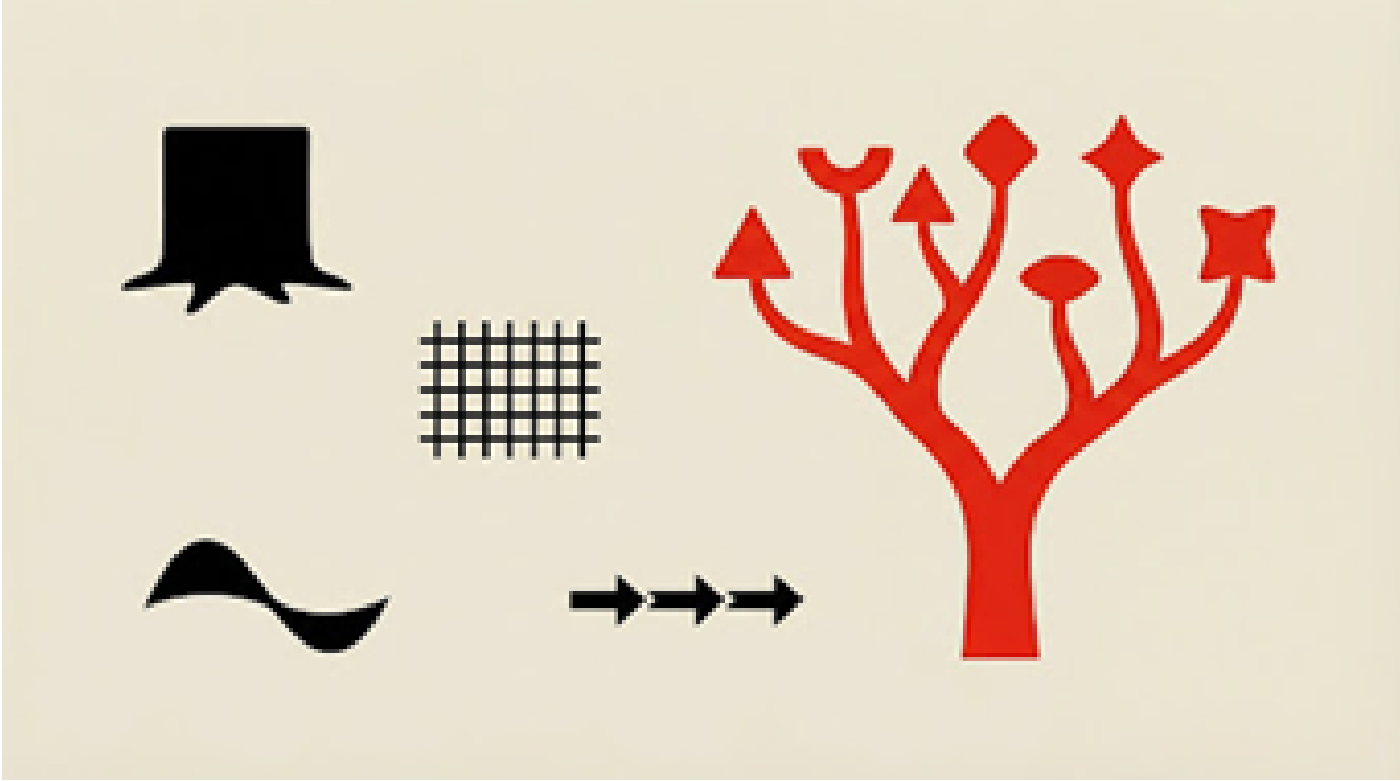
You get emergence. Reliably, robustly, everywhere you look. When lawful dynamics act on asymmetric conditions through causal time, systems develop structures and behaviors not trivially reducible to their parts. The history of anything interesting is a bushy tree of such emergences.
We can trace this tree from the Big Bang forward. Tiny density perturbations in the early universe—whether from deterministic initial conditions or from quantum fluctuations during inflation—get amplified by gravitational instability. Regions slightly denser than average attract more matter, becoming denser still, while regions slightly less dense lose matter and become emptier. Over billions of years, this process creates the cosmic web: filaments and voids, clusters and superclusters, galaxies and galaxy groups.
Within galaxies, gas clouds collapse under gravity to form stars. The collapse itself is driven by asymmetry—a perfectly uniform gas cloud would not collapse at all. Small density fluctuations grow, and once collapse begins, it proceeds rapidly. Stars form, ignite fusion in their cores, and begin a new chapter of emergence. Nuclear fusion converts hydrogen to helium, then in more massive stars to carbon, oxygen, and heavier elements. Each fusion reaction releases energy, maintaining the star in a far-from-equilibrium state for millions or billions of years.
When massive stars exhaust their fuel, they explode as supernovae, scattering heavy elements into interstellar space. This enrichment matters profoundly. The first generation of stars had only hydrogen and helium to work with. But subsequent generations form from gas clouds enriched with carbon, oxygen, silicon, iron—the raw materials for rocky planets and complex chemistry. Our Sun is at least a third-generation star, born from a nebula already seeded with the products of earlier stellar generations.
Around such stars, planetary systems form. Rocky planets like Earth provide platforms for chemistry far richer than what is possible in stars or interstellar space. The temperature range is moderate, allowing stable complex molecules. The presence of solid surfaces and liquid water creates interfaces and gradients that drive chemical reactions. Energy flows from sunlight maintain the system far from equilibrium for geological timescales.
Somewhere in this window—we do not yet know exactly where or how—life emerges. Whether it happens on Earth or arrives from elsewhere, life represents another branching point in the emergence tree. Living systems are complexes of autocatalytic chemistry that maintain themselves far from equilibrium by harvesting energy and materials from their environment. They reproduce with variation, allowing evolution to explore the space of possible designs. Over deep time, this process generates an astonishing diversity of forms and functions: metabolisms, membranes, multicellularity, nervous systems, cognition.
Human beings are one twig on this biological tree. We are not the apex or the goal—just one particular experiment in complexity that happens to have certain unusual properties, including the capacity for language, abstract reasoning, and cultural transmission. Culture itself then becomes another layer of emergence. Languages, tools, institutions, sciences, arts—each builds on biological capacities but exhibits dynamics not reducible to biology alone.
None of these emergent levels annul the ones beneath. Chemistry does not violate physics; it builds on physics while exhibiting patterns not directly derivable from quantum field equations. Biology does not violate chemistry; it uses chemistry to create living systems with properties—reproduction, metabolism, evolution—that chemistry alone does not explain. Culture does not violate biology; it depends on human brains and bodies but creates meanings and institutions that cannot be reduced to neurons firing.
This is the pattern all the way up and down. Each level inherits constraints from below while opening possibilities above. The lawful dynamics at each level, acting on asymmetries and gradients through causal time, reliably produce novelty.
A conversation emerges from neural firings but cannot be reduced to them. The meaning of words depends on context, history, culture, and shared understanding—all of which are real and explanatory without being reducible to neurotransmitter concentrations. A market emerges from individual transactions but exhibits its own dynamics—boom and bust cycles, price discovery, allocation of resources—that cannot be predicted from any single participant’s decisions. A poem emerges from words arranged on a page but means more than the dictionary definitions of those words. The meaning arises from structure, rhythm, metaphor, allusion, and the reader’s interpretation—all of which are real features of the poem, not imposed from outside.
Each of these is lawful without being predetermined, novel without being miraculous. The laws are enabling constraints, not deterministic scripts. They specify what is possible and how possibilities unfold, but they do not uniquely determine every outcome. Especially in a stochastic universe—if that is what we inhabit—quantum randomness at the base level propagates upward, creating genuine openness at higher levels. Even in a deterministic universe, sensitivity to initial conditions and computational irreducibility ensure that outcomes are novel and surprising even if they are in principle determined.
The pattern that builds galaxies from gas clouds also builds meanings from marks on a page. In both cases, lawful dynamics acting on asymmetric conditions through causal time generate structures that are real, novel, and irreducible. This is not magic. It is what lawful systems do when pushed far from equilibrium in rich environments through actual temporal becoming.
What Have We Spent?
What, metaphysically, have we spent to make sense of all this? Very little. We have not presupposed essences outside the world, nor a hidden theater behind appearances. We have not pledged to a single ultimate substance or a predetermined telos. We have not claimed that consciousness is fundamental or that mind pervades the cosmos. We have not invoked purposes or goals or hidden designers. We have made no commitments to mystical unities or transcendent realms.
We have only affirmed four commitments: that the universe exists and is real; that it exhibits or came to possess asymmetry; that it operates lawfully; and that causation through time is genuine. From these bare stakes, emergence does all the heavy lifting. The rich story of cosmic history—from quarks to galaxies to living systems to minds—follows as a consequence of these minimal assumptions plus the actual dynamics of the universe itself.
This minimalism is not austerity for its own sake. It is a discipline that partners with good epistemology. By “good epistemology” I mean methods that earn their keep: observation and measurement tempered by skepticism; models that make risky predictions and survive experimental tests; humility about error bars and the limits of current knowledge; openness to revision when new evidence demands it. Strong inference, Bayesian updating, reproducibility, peer review—all the practices that have made modern science successful.
The metaphysics stays thin so the epistemology can stay nimble. Too many a priori commitments, and inquiry ossifies into dogma. You spend all your time defending your elaborate metaphysical system instead of investigating the world. Too few commitments, and inquiry loses grip entirely. Without some minimal assumptions, you cannot even begin. The minimum viable set seeks the sweet spot: just enough firmness to stand on, just enough looseness to move and adjust as evidence accumulates.
“Emergence” in this framework is not a mysterious force or a kind of magic sprinkled from above. It is simply what lawful systems do when pushed off balance in environments rich with constraints and resources, unfolding through causal time. The novelty is real—genuinely new structures and behaviors that were not present before—but it is never inexplicable. Emergent phenomena can be understood in terms of the dynamics at their level without reducing them to the level below or invoking anything outside the natural world.
What This Buys Us
What does this stripped-down metaphysics buy us? Several things.
First, it frees inquiry from unnecessary baggage. We can study consciousness without solving the “hard problem” of how subjective experience arises from objective physical processes. We can investigate societies without reducing them to physics or claiming they are somehow independent of physical constraints. We can understand biology without waiting for a complete reduction to chemistry, and chemistry without waiting for a complete reduction to quantum field theory. Each level gets its own explanations, constrained by but not reducible to the levels below.
Second, it tells us where to look for interesting phenomena. Boundaries, gradients, far-from-equilibrium conditions, causal sequences—these are where novelty appears. The most interesting events in cosmic history happen at interfaces: between stars and their environments, between chemistry and biology, between biology and culture. These are the regions where energy flows, where matter cycles, where information accumulates, where new patterns emerge.
Third, it reveals the deep unity underlying diverse fields of inquiry. Cosmology, geology, chemistry, biology, neuroscience, sociology—these are not isolated disciplines studying unrelated phenomena. They are different windows onto the same emergence tree. The same basic pattern—lawful dynamics acting on asymmetries through causal time to generate novelty—plays out at every level. Understanding this unity does not erase the differences or make one field reducible to another, but it shows how they connect.
Fourth, it clears ground for thinking about meaning, value, and purpose without invoking anything transcendent or supernatural. These concepts remain contested and under-mapped; developing naturalistic accounts of meaning is work for another day. But minimum viable metaphysics is at least compatible with such accounts. It provides the layered, emergent naturalism within which meanings, values, and purposes could arise from the dynamics of complex adaptive systems, without requiring cosmic purposes or transcendent sources. The framework does not solve these problems; it creates space for addressing them.
Between the extremes of everything-reduces-to-physics and nothing-makes-sense lies a fertile middle ground. This is where minimum viable metaphysics operates. It rejects both reductionism (the claim that only the lowest level is real and explanatory) and dualism (the claim that higher levels require something outside the natural world to explain them). Instead, it embraces what we might call “emergent naturalism”: the view that nature is layered, with each layer exhibiting its own patterns and regularities, all grounded in the four basic commitments but none reducible to physics alone.
Is This Enough?
Is minimum viable metaphysics enough? For metaphysics to enable rather than obstruct understanding—yes. A thicker metaphysics may be psychologically consoling, but it is not required for intellectual traction. What we need is modest scaffolding that keeps inquiry honest, plus the epistemic discipline to make that scaffolding fruitful. The world itself does the rest.
Rich with gradients and departures from equilibrium, unfolding through causal time according to lawful dynamics, the universe generates the puzzles worth solving. Our job is not to impose grand metaphysical schemes on this process but simply to pay attention, measure carefully, model rigorously, and revise when evidence demands it.
Some will object that this is not enough. They will insist we need stronger commitments: to materialism or idealism, to determinism or free will, to reductionism or holism, to naturalism or supernaturalism. But notice that these debates become less urgent in the minimum viable framework. Materialism versus idealism is a debate about what is ultimately real, but minimum viable metaphysics does not require an answer. It needs only that something is real and lawful and causal. Whether that something is ultimately material, mental, or neutral between them can be left to further investigation.
Determinism versus indeterminism is likewise left open. As we have seen, minimum viable metaphysics is compatible with both a fundamentally deterministic universe (with initial asymmetry) and a fundamentally stochastic one (with emergent asymmetry from quantum processes). The question matters for physics, but for most purposes in biology, neuroscience, and social science, the effective dynamics are the same either way. Quantum randomness, if it exists, gets amplified through chaotic dynamics to produce unpredictability at macroscopic scales. Deterministic chaos produces similar unpredictability even without fundamental randomness. Either way, we get emergence, novelty, and open-ended evolution.
Reductionism versus holism similarly becomes less pressing. Minimum viable metaphysics commits to lawfulness at some level but does not insist that all higher-level regularities must be derivable from fundamental physics. If biology has its own robust laws not reducible to chemistry, that is fine. If psychology or sociology exhibit patterns not reducible to neuroscience, that is fine too. The framework is neutral on whether reduction succeeds or fails in any particular case. It needs only that each level exhibits some degree of lawfulness, whether that lawfulness comes from below or emerges at that level.
It is scaffolding, not a palace. It holds enough to start building, but it does not determine what the final structure will look like.
The Stance of Minimum Viable Metaphysics
Minimum viable metaphysics is, finally, not a destination but a stance. It is a decision about how to travel: light, with just the essentials, ready to adjust as the terrain demands. It carries realism with humility—yes, the world is real, but our understanding of it is provisional and incomplete. It carries lawfulness without dogma—yes, there are patterns and regularities, but our current theories may be approximations of something deeper. It carries temporal becoming without mysticism—yes, time is real and causation is genuine, but this is a natural feature of the universe, not evidence of anything supernatural. And it carries a principled expectation that non-equilibrium begets novelty—emergence is not magic but a reliable consequence of lawful systems driven far from equilibrium through causal time.
Partnered with good epistemology, this stance is enough—not to finish the book of the world, which may be impossible and is certainly far beyond our current reach, but enough to keep turning the pages with understanding. Enough to make progress. Enough to build on what we learn and revise what we thought we knew. Enough to do science, philosophy, and practical reasoning without getting bogged down in metaphysical quagmires.
The wager of minimum viable metaphysics is this: that the universe’s own restlessness—its gradients and imbalances, its lawful dynamics unfolding through causal time—will keep generating the puzzles worth solving. We do not need to carry the whole palace of being on our backs. We do not need answers to every metaphysical question before we can begin investigating nature. We need only four modest planks, well-placed and honestly held, to start crossing the stream as the stream keeps flowing.
Thanks for posting this.
Here's most of the answers: https://kaiserbasileus.substack.com/p/metaphysics-in-a-nutshell
It's not all that much in total.